Guide
Heat Pumps in Ottawa
Prices and sources read 2 November 2026. Last reviewed November 2026.
A cold-climate heat pump can heat an Ottawa house through most of the winter, with a backup for the deepest cold. Natural Resources Canada says most newer air-source models stop between -15°C and -25°C, and cold-climate models can work down to -30°C. Four Ottawa HVAC companies publish $7,000 to $18,000 for a ducted cold-climate system, before rebates.
On this page
- How much does a heat pump cost in Ottawa?
- Why heat pump quotes in Ottawa differ
- Will a heat pump keep up at -30 in Ottawa?
- Heat pump vs furnace in Ottawa
- The downsides of a heat pump in an Ottawa house
- How to get a heat pump installed in Ottawa
- Rebates: Ontario's programme and the new federal one
- How long a heat pump lasts
- Common questions
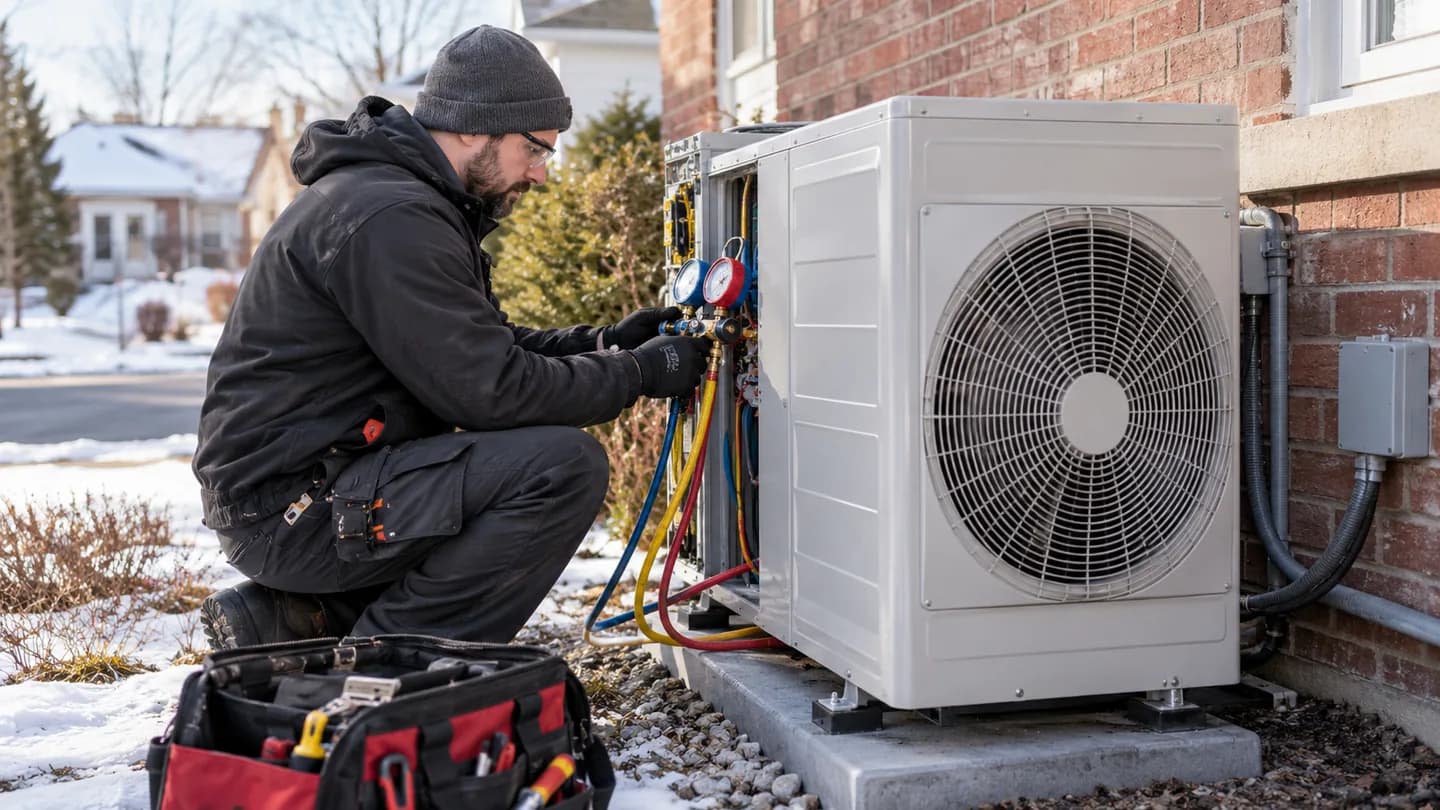
The low end is Dtech Services' figure and the high end is WeatherFix HVAC's. When you are ready for quotes, the HVAC companies in Ottawa listed in this directory are on one page, with their ratings and the areas they serve. To see which carry the most reviews, read our ranking of the best HVAC companies in Ottawa.
How much does a heat pump cost in Ottawa?
Five Ottawa HVAC companies publish installed heat pump prices, and each splits them by system type. They are shown side by side, not averaged, because the spread is the useful part. Every figure is before rebates and was read on each company's own page on 2 November 2026.
| Ottawa company | Cold-climate, ducted | Mini-split, one zone | Multi-zone ductless | Page date |
|---|---|---|---|---|
| Dtech Services | $7,000 to $12,000 | $4,500 to $7,000 | $8,000 to $15,000 | updated 2026-10-23 |
| Gas Man Ottawa | $8,000 to $12,000 | $3,500 to $5,500 | $8,000 to $14,000 (2 to 4 zones) | updated 2026-04-02 |
| AirZone HVAC Services | $8,000 to $12,000+ (premium cold-climate) | $4,000 to $6,000 | Not published; priced per design | October 2026 prices |
| WeatherFix HVAC | $10,000 to $18,000 | $3,500 to $5,500 | $7,000 to $15,000+ | updated 2026-09-28 |
| Reliable Home Environment | Not split out (see below) | $4,000 to $8,000 | $8,000 to $18,000+ | updated 2026-10-05 |
Reliable Home Environment lists a "cold climate heat pump" at $12,000 to $25,000+ without saying whether it is ducted or ductless, so it sits outside the ducted column. It is also the highest figure any Ottawa company prints for that kind of system.
Why heat pump quotes in Ottawa differ
NRCan says the cost depends on the type of system, your design goals, and the heating equipment and ductwork already in the house. The items Ottawa quotes most often add:
- Electrical capacity. Gas Man Ottawa says a heat pump needs a dedicated 240 V circuit and an older 100-amp panel may need upgrading to 200 amps. It puts that upgrade at $500 to $2,000, Dtech Services at $1,500 to $3,000, and WeatherFix HVAC prices electrical upgrades at $500 to $2,500.
- Ductwork. NRCan says heat pumps move more air than furnaces, so ducts sized for a furnace may need changes to avoid noise and extra fan energy.
- Cold-climate or standard. Gas Man Ottawa and WeatherFix HVAC both price a standard ducted heat pump below a cold-climate one, so check which the quote is for.
- Zones. Each extra indoor head on a ductless system adds equipment and line runs; in the table, multi-zone prices start about where ducted ones do.
- Mounting. WeatherFix HVAC lists snow stands and brackets for the outdoor unit as a separate cost, so ask whether the quote includes one.
For furnace, air conditioning and wider HVAC prices from the same and other Ottawa publishers, see our HVAC cost guide for Ottawa. The electrician's side of a panel upgrade is priced in our Ottawa electrician cost guide.
Sizing: why square footage is not the answer
NRCan recommends a heating and cooling professional work out your loads with CSA F280-12, "Determining the Required Capacity of Residential Space Heating and Cooling Appliances". One ton of heat pump capacity is 12,000 Btu/h, but two houses of the same area can need different tonnage once insulation, windows and air leakage are counted.
Getting it wrong costs either way. Undersized, the backup heat runs more often and the savings shrink. Oversized, the unit cycles on and off in mild weather, which NRCan says brings discomfort, wear and standby power draw.
Will a heat pump keep up at -30 in Ottawa?
Not on its own every hour of every winter, and NRCan says so plainly. An air-source heat pump pulls heat from outdoor air, and the colder that air, the less heat it can move. At 8°C NRCan puts the coefficient of performance at 2.0 to 5.4; at -8°C it falls to 1.1 to 3.7.
Two NRCan pages give the temperature limits. Its heat pump guide says most air-source heat pumps have a minimum operating temperature, between -15°C and -25°C for newer models, below which a supplementary system must heat the house. Its heat pump basics page says cold-climate air-source heat pumps can work well below freezing, down to -30°C.
Between those two lies the thermal balance point: the outdoor temperature at which the heat pump's output equals the house's heat loss. Below it, backup heat makes up the difference. NRCan also flags the defrost cycle, when the unit briefly reverses to melt frost off the outdoor coil and the backup covers the gap.
Cold-climate heat pumps: what to check on the quote
"Cold climate" is a listing, not a slogan. Ontario's Home Renovation Savings Program pays only for a model on NRCan's qualified list of cold climate air source heat pumps. Before you sign, ask for:
- the exact outdoor and indoor model numbers, and the AHRI number
- proof the model is on NRCan's cold climate list, and its HSPF for Region V, which NRCan says is a climate similar to Ottawa
- the steady-state heating rating at -8.3°C, which NRCan says separates units with similar HSPF
- the maker's spec sheet showing capacity and the lowest operating temperature
- demand-defrost control, which NRCan prefers over a timer
- the outdoor unit's sound rating; NRCan says most are 76 dB or lower
A claim that a model "works at -30" is only as good as the spec sheet behind it. Ask for the capacity figure at that temperature, not just the cut-out point.
Heat pump vs furnace in Ottawa
Most Ottawa installs are not a choice between the two. NRCan describes two ways to back a heat pump up. In an all-electric system, resistance elements in the ducts or baseboards cover the cold hours. In a hybrid system, a furnace or boiler does, and NRCan calls that a good option when the heat pump replaces a central air conditioner.
On efficiency, NRCan's pamphlet for homes moving from gas says a cold-climate heat pump heats up to 3.5 times more efficiently than a gas furnace, and a gas hybrid up to 2 times more than the furnace alone, averaged over a winter.
Efficiency is not the bill, though. The federal National Heat Pump Rebate page warns that a household heating with natural gas may not see lower heating bills after switching, depending on region and system. NRCan says the savings depend on the price of electricity against gas or oil, so ask the contractor to estimate from your own last winter of bills.
In a hybrid set-up, NRCan suggests asking what the controls use to switch between heat pump and furnace: an outdoor temperature, the electricity rate, or both. That one setting decides how much of the winter the heat pump actually carries.
The downsides of a heat pump in an Ottawa house
Each of these comes from NRCan's guide, and none is a reason to rule one out. They are what to plan around:
- Output drops as it gets colder, and most models stop below -15°C to -25°C, so you need a backup.
- Supply air is 25 to 45°C, against 55 to 60°C from a furnace, so a register feels cooler even when the room is warm.
- Higher airflow can mean duct changes, or added noise and fan energy without them.
- It recovers slowly from a deep night setback; NRCan suggests 2°C at most.
- Defrost cycles cost some energy, more with a timer than with demand-defrost.
- Savings depend on electricity prices against your current fuel, and may not appear on gas.
How to get a heat pump installed in Ottawa
- Start before the old system fails. NRCan says to allow as much as a year for electrical upgrades and other work.
- Get a load calculation. Ask each contractor how they sized the unit; the answer should be CSA F280, not square footage.
- Check the electrical side. A new circuit or panel is electrical work. Our furnace installation guide explains who may do the gas, refrigeration and electrical parts of an HVAC job in Ontario, and how to check each licence.
- Line up rebates before the install. Ontario's programme says pre-approval is mandatory and installs done before approval are not eligible.
- Keep the paperwork. The federal rebate needs a receipt naming you, the installer, the make, model and AHRI number, how many units, and the full project cost.
- Book yearly service. NRCan wants a qualified contractor once a year, and a filter change or clean from you every 3 months.
Choose your installer yourself. Canada.ca says salespeople are visiting and calling homes with misleading tactics that cite the federal rebate, and that Environment and Climate Change Canada never goes door to door to sell or inspect heating equipment. Start the conversation with a company you found.
Rebates: Ontario's programme and the new federal one
Ontario's rebate depends on how the house is heated now, and an Enbridge gas customer gets less than a home on electricity, oil or propane. The amounts, tonnage rules and who qualifies are in our guide to the Home Renovation Savings Program in Ottawa.
The federal government added a second one. Canada.ca's National Heat Pump Rebate page, announced on 2026-10-08 and read on 2 November 2026, says:
- applications are expected to open through an online portal in early 2027, and the programme to close in March 2034
- households above median income may get $2,000; at or below median after-tax income, up to $10,000
- installs from November 1, 2026 can claim retroactively once it opens, with receipts sent within 6 months
- the heat pump must be on the eligible product list by AHRI number and installed by an HVAC contractor
- emergency and planned installs both count, and you do not have to remove the old system
- no energy audit before or after, and one rebate per household
Canada.ca says the programme's parameters are still being finalized and may change, and that no payment is made until an application is approved. Check the page again before you buy.
How long a heat pump lasts
NRCan puts an air-source heat pump's service life at 15 to 20 years, with the compressor as the part that decides it. The usual warranty is one year on parts and labour plus five to ten years on the compressor, parts only, though it varies by maker, so NRCan says to read the fine print.
Common questions
- How much does it cost to install a heat pump in Ottawa?
- For a ducted cold-climate system, Dtech Services publishes $7,000 to $12,000 installed, Gas Man Ottawa $8,000 to $12,000, AirZone HVAC Services $8,000 to $12,000+ and WeatherFix HVAC $10,000 to $18,000, all before rebates. A single-zone ductless mini-split runs $3,500 to $5,500 at Gas Man and WeatherFix and $4,000 to $8,000 at Reliable Home Environment. A panel upgrade, duct changes or a second zone add to it.
- Do heat pumps work in Ottawa winters?
- Yes, with a backup. NRCan says cold-climate air-source heat pumps can work down to -30°C, but also that most newer air-source models have a minimum operating temperature between -15°C and -25°C and give less heat as it gets colder. Below the point where output matches the house's heat loss, a furnace or electric elements make up the rest.
- What is the major disadvantage of a heat pump?
- Its output falls as the outdoor temperature falls, just when an Ottawa house needs the most heat, so it needs a backup. NRCan also lists a cooler supply air than a furnace, defrost cycles, higher airflow that can mean duct changes, slower recovery from a deep thermostat setback, and running costs that depend on the price of electricity against gas or oil.
- Is a heat pump worth it in Ontario?
- It depends on what it replaces. NRCan says a cold-climate heat pump heats up to 3.5 times more efficiently than a gas furnace over a winter, and up to 2.5 times more than baseboards. But the federal rebate page warns that a home heating with natural gas may not see lower bills, depending on region and system. Ask your installer for an estimate built on your own fuel bills.
- Who qualifies for a free heat pump in Ontario?
- No programme this page read gives one away outright. The largest amounts go by income: the federal National Heat Pump Rebate offers up to $10,000 to households at or below median after-tax income, from early 2027. Ontario's Home Renovation Savings Program pays by heating fuel and tonnage, and our guide to it covers who qualifies.
- How much is a heat pump for a 2000 sq ft house?
- Floor area does not set the size. NRCan says heating and cooling loads should be worked out with CSA F280-12, which accounts for insulation, windows, air leakage and Ottawa's climate, so two 2,000 sq ft houses can need different units. Once the size is known, the Ottawa price lists in this guide give the installed range for that type of system.
- What size heat pump do I need for a 1500 or 1700 sq ft house?
- Ask for the CSA F280 heat loss calculation before you compare tonnage. A ton is 12,000 Btu/h of capacity, NRCan says, and a quote should state the capacity the unit delivers at Ottawa's cold, not only its rating at mild test conditions. A contractor who sizes from square footage alone has skipped the step NRCan recommends.
- What happens if a heat pump is too big or too small?
- Too small, NRCan says, and the backup heat runs more often, so you lose the savings you paid for. Too big, and in mild weather it makes too much heat and cycles on and off, which costs comfort, wears the heat pump and adds standby power draw. Both come from skipping the load calculation.
- What is the lifespan of a heat pump?
- NRCan puts an air-source heat pump's service life at 15 to 20 years, with the compressor as the critical part. Most come with a one-year parts and labour warranty and a further five to ten years on the compressor, for parts only, but NRCan says to read the fine print because warranties vary by maker.
- Is it cheaper to run a heat pump or an air conditioner?
- In summer they are the same machine. NRCan says the outdoor unit of a heat pump looks and works like the outdoor part of an air conditioner, and both are rated on SEER, with a Canadian minimum of 14. Compare the SEER of the two quotes; the heat pump's advantage is that it also heats.
- Can a heat pump replace my furnace?
- It can replace the furnace's job with an electric backup, or work beside the furnace. NRCan describes both: all-electric, with resistance elements in the ducts or baseboards, and hybrid, where a furnace takes over in deep cold. NRCan calls hybrid a good option where a heat pump replaces a central air conditioner. The federal rebate does not require you to remove the existing system.
- Is it possible to replace my central air unit with a heat pump?
- Yes. That is the hybrid set-up NRCan describes: the heat pump goes where the air conditioner was, uses the existing ductwork, and the furnace stays as the backup. Ask the contractor what outdoor temperature or electricity rate the controls will use to switch between them.
- Why is my house cold with a heat pump?
- Often because it feels different, not because it is failing. NRCan says a heat pump sends more air at 25 to 45°C, where a furnace sends less air at 55 to 60°C. On the coldest nights, below the balance point, the heat pump cannot cover the whole load and the backup has to. A deep night setback also leaves it slow to catch up.
- Why is my bill so high with a heat pump?
- The usual cause is the backup doing the work. NRCan suggests setting electric backup heat 2 to 3°C below the heat pump's set-point, keeping setbacks to 2°C or less, changing or cleaning the filter every 3 months, and having demand-defrost control so the unit does not defrost when it does not need to. An undersized unit also leans on backup heat.
- Should a heat pump run all the time, and how many hours a day?
- Long run times are normal. NRCan says variable-speed units vary their output to match the house, so in cold weather they run steadily at part output rather than switching on and off. It recommends against deep setbacks: keep them to 2°C or use a smart thermostat that starts recovery early.
- Do heat pumps use a lot of electricity?
- They use less electricity per unit of heat than any resistance heater. NRCan gives a coefficient of performance of 2.0 to 5.4 at 8°C, meaning 2 to 5.4 units of heat per unit of electricity, falling to 1.1 to 3.7 at -8°C. A house that switches from gas will still use more electricity than before, because the heat now comes from the grid.
- Which heat pump brands are best for cold climates?
- This directory does not rank brands. Check the specific model, not the brand: it must be on NRCan's cold climate air source list to earn Ontario's rebate, and on the federal eligible products list by AHRI number for the federal one. NRCan says to compare the steady-state rating at -8.3°C between units with similar HSPF, and the maker's spec sheet for capacity at colder temperatures.
- What is the quietest heat pump?
- Compare the outdoor unit's sound rating in decibels on each quote. NRCan says the lower the number, the less sound the unit emits, and that most heat pumps are rated at 76 dB or lower. Placement matters too: ask where the outdoor unit will sit relative to bedrooms and the neighbour's windows.
- How often do heat pumps need servicing?
- Once a year by a qualified contractor, NRCan says, plus your own filter change or cleaning every 3 months and keeping vents and registers clear of furniture and rugs. Poor airflow shortens the equipment's life and lowers its efficiency.
- When is the best time to replace a furnace or AC with a heat pump?
- Before it fails. NRCan says not to wait for an emergency replacement and to allow as much as a year for electrical upgrades and other work. Ontario's programme also requires pre-approval before installation, which a breakdown in January leaves little time for. The federal rebate accepts emergency installs, but only on listed equipment.
- What is the most efficient way to heat a house in Canada?
- Of the heat pump types, ground source. NRCan says a well-designed ground-source system saves about 10 to 20 per cent more than a best-in-class cold-climate air-source heat pump, because the ground stays warmer than winter air, and it needs no defrost cycle. The ground loop is a separate system to design and install, so get it priced on its own.
Read NRCan's full heat pump guide before you compare quotes.
NRCan: heating and cooling with a heat pump