Guide
Ottawa Tree Bylaw: City Trees, Boundary Trees, Root Zones and Permits
Last reviewed 12 November 2026.
Ottawa's tree bylaw is the Tree Protection By-law, No. 2020-340, in force since January 1, 2021. It protects every City-owned tree, urban and rural, and private trees in the urban area above a set trunk size. Injuring or removing a protected tree needs a City permit, and damaging its roots counts as injury.
On this page
- Can I cut down a tree on my property in Ottawa?
- Ottawa's tree bylaw, part by part
- Where the by-law applies: urban, rural and the growth areas
- How to measure a tree the way the by-law does
- What is the critical root zone of a tree?
- Who looks after the tree between the sidewalk and the road?
- How close to a property line can you cut trees?
- Can I make my neighbour cut back their tree?
- Who is responsible if a tree falls?
- What permission is required to cut a protected tree?
- The dead-tree exemption has conditions
- What enforcement looks like
- What a tree service should handle for you
- Before anyone cuts
- Common questions
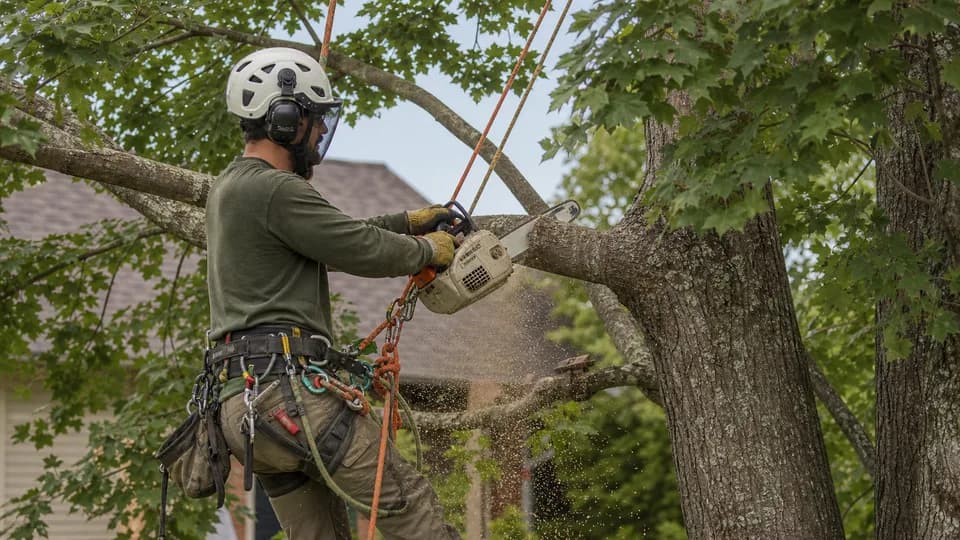
Everything below is read from the City's consolidation of the by-law and the Ontario statutes beside it, on 12 November 2026. The trunk sizes, the permit fee and the fine range are in our Ottawa tree removal cost guide. This page covers the rest: the City's tree at the curb, the tree on the line, the root zone, and each step of the application.
Can I cut down a tree on my property in Ottawa?
Often, yes. It depends on three facts: who owns the trunk, where the lot sits, and how wide the trunk is at 130 cm off the ground. A private tree under the size threshold, or one outside the urban area and the by-law's named growth areas, is outside its private-tree parts.
Pruning a private tree needs no permit when it keeps the tree healthy and follows good arboricultural practice (section 82).
Three situations change the answer:
- The tree is the City's. That includes the one on the grass between the sidewalk and the road, which you may not even trim.
- Part of the trunk crosses the property line. Then it belongs to both owners, and cutting it without your neighbour's consent is a provincial offence.
- You are building. A protected tree near the work, including your neighbour's, has to be fenced off at its critical root zone, and an infill building permit needs a Tree Information Report.
Ottawa's tree bylaw, part by part
The by-law runs to 105 sections in ten parts, plus Schedules A to P. Council passed it on November 25, 2020, and it repealed the two older tree by-laws.
| Part | What it covers |
|---|---|
| I, General | Definitions. The by-law applies to all land inside the City's limits unless a part says otherwise, and permits cannot be transferred. |
| II, Trees on municipal property | Every City-owned tree, urban and rural, including a boundary tree that is partly on City land. |
| III, Municipal natural areas | What you may not do in City-owned natural areas, conservation forests and woodlands, and when a consent to enter permit is needed. |
| IV, Private property over 1 ha | Trees 10 cm and up in the urban area and in the lands on Schedules G to O, and on smaller lots under a site plan, subdivision or condominium application. |
| V, Distinctive trees, 1 ha or less | Trees 30 cm and up on private urban lots of one hectare or less, or larger lots with an existing condominium or multi-residential building. |
| VI, Tree protection | Fencing at the critical root zone, and what may not happen inside it, for every protected tree. |
| VII, Indemnification and insurance | The applicant indemnifies the City and carries $1,000,000 or $2,000,000 of liability insurance. |
| VIII, Exemptions | Statutory exemptions, and the private-tree exemptions: pruning, a dead tree confirmed by an arborist, an immediate hazard, and others. |
| IX, Enforcement | Inspection, stop work orders, offences and fines. |
| X, Administration | Repeals the 2009 Urban Tree Conservation By-law and the 2006 Municipal Trees and Natural Areas Protection By-law. |
Four definitions that decide most cases
- Tree: any woody perennial plant, roots included, that has reached or can reach 450 cm tall at maturity. A shrub that will never pass 4.5 m is outside the by-law's tree rules.
- DBH: the trunk measured 130 cm from the ground.
- Injure: any act that harms a tree's health, including failing to protect it to the City's standards.
- Destroy: damage so severe the tree cannot recover and has to come down.
Where the by-law applies: urban, rural and the growth areas
The two private-tree parts apply inside the urban area. The by-law defines it as the lands on Schedule B, Urban Policy Plan, of the City's Official Plan, plus the hatched lands on the by-law's own Schedule A, which covers urban expansion areas.
Part IV also reaches the additional lands on Schedules G to O: South March, Stittsville, Barrhaven North, Barrhaven South, Riverside South, Leitrim West, Tewin, Orleans South and Orleans North. Schedule P adds lands in Orleans.
Outside the urban area and those schedules, a privately owned tree falls under neither private-tree part. City-owned trees are still protected there, and so are City natural areas under Part III. The Forestry Act's boundary-tree rule, covered below, is provincial and has no urban or rural split. The City says the areas each part covers are drawn on geoOttawa under the Forestry heading.
How to measure a tree the way the by-law does
The City's measuring page gives two methods at 1.3 m (51 inches) above the ground. For a quick estimate, hold a metre stick against the trunk and read across. For a precise figure, wrap a tape around the trunk and divide the circumference in centimetres by 3.1416. A 30 cm trunk measures 94 cm around.
The same page sets the awkward cases:
- Several stems: measure every stem at 1.3 m. If any one stem reaches the threshold, the whole tree is a distinctive tree.
- On a slope: measure at 1.3 m at the centre of the trunk, so the height is the average of the short and long sides.
- Leaning: measure 1.3 m along the trunk's own angle.
- Forked: measure the narrowest part of the main stem below the fork, and record both heights. If the fork is too high to reach, measure at 1.3 m.
One caution. That page, dated July 31, 2024, still gives 50 cm for urban lands outside the Greenbelt. The by-law's own definition, read on 12 November 2026, makes a distinctive tree 30 cm or more anywhere in the urban area. Measure against the by-law.
What is the critical root zone of a tree?
Under section 1, it is the land within 10 cm of the trunk for every 1 cm of trunk diameter, measured as a radius. A 30 cm maple has a critical root zone 3 m out in every direction. A 60 cm oak has one 6 m out, which on a city lot often crosses the fence into the next yard.
Part VI applies that zone to every protected tree, including one on the neighbouring lot whose roots reach yours. Unless the City authorizes otherwise:
- Tree protection fencing at least 1.2 m high goes around the outer edge of the zone before any work starts, built so it cannot be moved, and stays until the work is done (section 74).
- Inside the zone, no one may store material or equipment, outhouses included, raise or lower the grade, or extend a hard surface or significantly change the landscaping (section 76).
- No one may damage the roots, trunk or branches, attach signs to the tree, or point equipment exhaust at its canopy (section 77).
Where the fenced area has to shrink for construction, section 75 has an arborist prescribe the mitigation: plywood, wood chips or steel plates over the roots, proper root pruning, or tunnelling and boring instead of open digging. The City's protecting trees page states that failing to protect a tree not approved for removal is an offence.
The by-law's report guidelines list widening a driveway and installing a service, a pool or a deck among the ordinary projects that bring a tree into a permit file.
Who looks after the tree between the sidewalk and the road?
The City does, and you may not touch it. The by-law counts a highway as the whole area between its lateral property lines, so a boulevard tree is a municipal tree. Section 11 bars anyone, without the City's authorization, from removing its branches, trimming or altering it, injuring its roots, fixing a sign, guy line or tree paint to it, or working in its critical root zone.
Getting the City to act
The City's tree care page says to call 3-1-1 at once for a tree or branch on a house or a vehicle, across the road or sidewalk, or leaning on utility wires, and that urgent requests cannot go online.
A health inspection, a pruning request or a wasp nest in a City tree can be requested online. If you are not sure the tree is the City's, you can ask a Forestry inspector to decide.
When a City tree may come down
Section 17 lets the City remove a City tree that is dead, an immediate threat, diseased or broken, or causing serious damage to private property that nothing else will stop. Anyone else needs a tree permit backed by an arborist's Tree Information Report (sections 18 to 20).
Section 24 covers one narrow case: a City tree that by its very existence blocks access to your property, where you show no practical option exists and pay its value.
Schedule B values a City tree, whatever the reason it comes out, by the CTLA trunk formula or a replacement ratio, whichever is greater, with a $400 minimum per tree, plus $400 more where a replacement cannot be planted. The permit then has to be posted on the adjacent private property for seven days before and after the work (section 25).
If you think it is cracking your foundation
The City's trees near foundations page says the soil is often the cause, and names shrinkage of sensitive marine clay as a major contributor in Ottawa. A mature City tree suspected of damage goes through a formal 4-phase assessment, which starts with a call to 3-1-1. The by-law's report guidelines require that process for any request to remove a City tree for that reason.
How close to a property line can you cut trees?
The by-law sets no distance. What decides it is where the trunk grows, and the by-law sorts trees four ways:
- Yours: the trunk is wholly on your lot.
- Boundary tree: any part of the trunk grows across a property line.
- Adjacent tree: the trunk is on the neighbouring lot, though its roots or branches reach yours.
- Municipal tree: any tree completely or partly on City land. A boundary tree that straddles City and private land counts as the City's (section 3).
A boundary tree belongs to both of you
Ontario's Forestry Act says so in section 10 (2): a tree whose trunk grows on the boundary is the common property of both owners. Section 10 (3) makes it an offence to injure or destroy it without the owners' consent, and section 19 sets the penalty at a fine of up to $20,000, up to three months in jail, or both. That rule applies anywhere in Ontario, rural Ottawa included.
Ottawa's by-law adds its own step. Sections 47 and 63 require the other owner's written consent with any permit application for a boundary tree, and the report guidelines say a removal permit will not be issued without each owner's consent.
Your neighbour's tree
The City's rules for tree permits say it cannot issue a permit to injure or destroy a tree on an adjacent property unless the tree's owner asks. If that tree is protected, Part VI still applies to the part of its root zone on your side, and a full Tree Information Report has to map it.
Can I make my neighbour cut back their tree?
Nothing in the by-law lets one neighbour order another to prune. The City's ownership page is plain that its inspectors will not decide who owns a tree between two private properties, which it calls a civil matter. Two rules still bind whoever does the cutting.
A shared trunk needs both owners' consent under the Forestry Act, and pruning that harms a protected tree's health is injury under the by-law. Only pruning for the tree's health, done to good arboricultural practice, is exempt.
Who is responsible if a tree falls?
Ontario law answers one case directly. Under section 22 of the Line Fences Act, if a tree falls and damages a line fence, the owner or occupant of the land it stood on has to remove it and repair the fence at once.
If they have not done so 48 hours after written notice, the neighbour may, may keep the tree to cover the work, and may recover the cost. Our Ottawa fence bylaw guide covers the rest of that Act.
For a City tree that has come down on a house, a car, a road or a wire, call 3-1-1. Who pays when a private tree falls on a neighbour's house is outside the by-law and the statutes quoted here, and between private owners the City treats it as a civil matter.
What permission is required to cut a protected tree?
A distinctive tree permit for a private tree on a lot of one hectare or less, or a tree permit for a City tree or a tree on a larger lot. For the small-lot case, the application works like this:
- Hire an arborist. The by-law's definition includes an arborist qualified by the Ontario ministry, an ISA certified arborist, an ASCA registered consulting arborist, a Registered Professional Forester, or someone with similar qualifications the City approves.
- Get the right report. Removal for the tree's condition takes a short Tree Information Report. Removal for development, construction or demolition, or work inside a protected tree's root zone, takes the full one, with every tree on the site, boundary and adjacent trees included, plotted on the grading and site plans.
- Collect the signatures. The owner, the arborist and the contractor, if known, sign a self-declaration agreeing to the report's measures and accepting that an inspector may enter the property. A boundary tree also needs the other owner's signature.
- Submit and pay online. The City's online form takes the report and the fee together. The fee is per tree and non-refundable, so list only trees that need a permit. Schedule D stops charging after five trees, so the most it reaches is $1,000, or $6,200 for infill.
- Show insurance. $1,000,000 where the applicant is not a contractor (section 80), or $2,000,000 naming the City as an additional insured where the applicant is a contractor or developer (section 79).
- Wait for a decision. The City may issue the permit, attach conditions, or refuse (section 65).
- Post it, then replant. Post the permit on the property and the tree before the work, and plant what Schedule B requires afterwards.
The grounds the City weighs
Section 66 lists them: the tree is dead, diseased or badly injured and unsafe; it is damaging or likely to damage a load-bearing or roof structure; it has to go to clean up contaminated soil; it is shown on plans approved by the tribunal, Council or a final Committee of Adjustment decision; you have undertaken satisfactory landscaping, replanting or preservation; or there is no reasonable alternative.
The City may also accept other circumstances.
A condition-based request has to show its evidence. The Tree Information Report page asks the short report to weigh pruning or cabling as ways to keep the tree, and the guidelines may call for a tree risk assessment, a decay test, or an engineer's report where damage is claimed. Section 67 lets the City require that the work be done or supervised by an arborist, and set its timing.
If you are building
Section 62 requires a Tree Information Report with any infill building permit or Committee of Adjustment application in the urban area. The tree permit is issued with the building, demolition or pool enclosure approval, but the City says those approvals do not themselves allow a tree to be removed. A site with no trees still needs a statement saying so on the grading or site plan.
The City's rules page says it will generally permit removal of a tree inside the as-of-right building envelope, and will look to keep street trees and rear-yard trees. Trees close to the envelope are decided case by case.
What replanting looks like
Schedule B sets the replacement tree: deciduous stock at least 50 mm across, measured 15 cm above the ground, or a conifer at least 200 cm tall, of a non-invasive species. If it cannot go on your lot, it may go on a nearby property with that owner's approval.
Each infill replacement you cannot plant costs $400. The schedule's own example: a 54 cm tree needs three replacements, so planting one leaves $800 owed.
The dead-tree exemption has conditions
Section 82 is narrower than most summaries make it. It exempts a private tree that is dead as confirmed by an arborist, or one that is an immediate threat to public health and safety. The City also asks for photographs before removal as evidence. A homeowner's own view that a tree is dead is not what the section says.
An exempt removal still carries a duty. Schedule D sends dead, hazardous and ash trees to the exemption process, and Schedule B lists 1:1 replacement planting for a private urban tree of any size removed as dead, hazardous or ash. The City's general information page adds that every ash removed must be disposed of inside the Canadian Food Inspection Agency's regulated areas.
What enforcement looks like
A municipal law enforcement officer may enter land, though not a building, at any reasonable time to inspect (section 84), take photographs, and require the Tree Information Report (section 86). The City may issue a stop work order, served in person, by email, by registered mail or by posting it on the property (sections 90 to 96). Knowingly giving false information for a permit is its own offence (section 71).
On conviction, section 101 lets the court order that the offence stop and that the contravention be corrected, on top of any fine. One figure differs between two City sources. Section 100 of the consolidation sets the daily maximum for defying a stop work order at $10,000. The City's enforcement page gives $100,000 a day.
What a tree service should handle for you
On 12 November 2026, our listings for tree removal in Ottawa showed 21 tree services, 20 of them with a sourced public rating. Whichever you call, the by-law gives the company specific work. Ask whether it will:
- Measure the trunk at 130 cm, every stem, and write the figure down.
- Establish ownership: yours, the City's, a boundary tree, or your neighbour's.
- Prepare the Tree Information Report through an arborist who meets the by-law's definition, and sign the self-declaration.
- Show a certificate for $2,000,000 of liability insurance naming the City, if it is the applicant.
- Confirm a dead tree in writing, as an arborist, with dated photographs.
- Put up protection fencing at the root zone of every tree that stays.
- Check federal and provincial rules. The report guidelines name the Endangered Species Act and the Migratory Birds Convention Act, and may require a butternut health assessment.
- Dispose of ash inside the regulated areas, and plant the replacement to spec.
Our comparison of Ottawa tree care companies by review volume is one place to start a shortlist.
Before anyone cuts
- Find out who owns the trunk. If a City tree is involved, ask Forestry Services.
- Check whether the lot is in the urban area or a named growth area on geoOttawa.
- Measure at 1.3 m, every stem, and compare against the by-law, not an old page.
- If the trunk crosses the line, get your neighbour's written consent.
- Fence the root zone of every protected tree near the work before it starts.
- Apply online with an arborist's report, and post the permit before the work.
- Plant the replacement Schedule B requires, including after an exempt removal.
Sources, read 12 November 2026:
- City of Ottawa: Tree Protection (By-law No. 2020-340)
- City of Ottawa: Tree Protection By-law, general information
- City of Ottawa: Tree permits and compensation
- City of Ottawa: Tree Protection By-law, enforcement
- City of Ottawa: Submit your Tree Information Report online
- City of Ottawa: Protecting trees
- City of Ottawa: Tree Information Report
- City of Ottawa: General rules for considering tree permits
- City of Ottawa: How to measure a tree
- City of Ottawa: City tree care and maintenance
- City of Ottawa: Determine ownership of a tree
- City of Ottawa: Trees near foundations
- Government of Ontario: Forestry Act, R.S.O. 1990, c. F.26
- Government of Ontario: Line Fences Act, R.S.O. 1990, c. L.17
Tree care companies you can start a shortlist from
The by-law decides what may come down and how. Here are the tree services in this directory carrying a rating we can source, with the platform it came from, the date it was checked, and the areas each one lists.
- Green Thumb Tree Specialists
4.9 from 222 Google reviews, checked 2026-08-19
Serves Kanata, Nepean, Barrhaven, Orléans, Manotick
- Manotick Tree
5.0 from 217 Google reviews, checked 2026-08-14
- Best Green Hedges
5.0 from 214 Google reviews, checked 2026-08-19
Serves Barrhaven, Gloucester, Kanata, Manotick, Nepean, Orléans, Stittsville
- Crisp Cuts Lawn Care
5.0 from 163 Google reviews, checked 2026-11-12
Serves Kanata, Stittsville, Manotick
- Croft Tree Experts
4.9 from 803 Google reviews, checked 2026-08-19
Serves Barrhaven, Kanata, Nepean, Orléans, Manotick, Stittsville, Gloucester
- Tree King
5.0 from 147 Google reviews, checked 2026-08-19
Serves Kanata, Barrhaven, Orléans, Nepean, Westboro, Gloucester, Stittsville, Manotick
- Ottawa Tree Trimming
5.0 from 118 Google reviews, checked 2026-08-19
Serves Richmond
- ZZ Chop Tree Care
5.0 from 71 Google reviews, checked 2026-08-14
Serves Barrhaven, Gloucester, Kanata, Nepean, Orléans
That is the top 8 of 20 Ottawa tree services in this directory carrying a sourced rating. Only listings whose rating carries a source appear here. No business pays for a listing. Claimed listings, the ones a business maintains itself, rank first, and the rest of the order is published on the methodology page. See all of them on Tree Service in Ottawa.
Common questions
- What is the tree bylaw in Ottawa?
It is the Tree Protection By-law, No. 2020-340, passed on November 25, 2020 and in force since January 1, 2021. It protects every City-owned tree in the urban and rural area, City natural areas, and private trees in the urban area above a set trunk size.
Injuring or destroying a protected tree needs an approval or permit from the City, and the by-law's definition of injure includes failing to protect a tree to the City's standards.
- Can I trim the City tree in front of my house in Ottawa?
Not without the City's authorization. Section 11 of the by-law says no person shall remove branches, trim or alter a municipal tree, injure its trunk, branches or roots, or attach a sign, guy line or fastening to it, unless the General Manager has authorized it.
The by-law's definition of a highway includes the whole area between the lateral property lines, so a tree on the boulevard is a City tree. Ask Forestry Services for pruning through the City's online request, or call 3-1-1 if a branch is a hazard.
- Do I need a permit to remove a dead tree in Ottawa?
No permit, but there are conditions. Section 82 exempts a private tree that is dead as confirmed by an arborist, or that is an immediate threat to public health and safety. The City asks for photographs before removal as evidence of the tree's condition.
Schedule D says dead, hazardous and ash trees follow the exemption process, and Schedule B lists 1:1 replacement planting for a private urban tree of any size removed as dead, hazardous or ash.
- Who owns a tree on the property line in Ontario?
Both owners. Section 10 (2) of Ontario's Forestry Act makes every tree whose trunk grows on the boundary between adjoining lands the common property of both owners, and section 10 (3) makes it an offence to injure or destroy it without their consent, with a fine of up to $20,000, imprisonment for up to three months, or both under section 19.
Ottawa's by-law calls it a boundary tree and requires the other owner's written consent with any permit application.
- What is the critical root zone under Ottawa's tree bylaw?
The area within 10 cm of the trunk for every 1 cm of trunk diameter, measured as a radius. A tree 30 cm across at breast height has a critical root zone 3 m out from the trunk.
Section 74 requires tree protection fencing at least 1.2 m high at the outer edge of that zone before work starts on a site with a protected tree, and section 76 bars storing material, changing the grade or extending a hard surface inside it.
- What insurance does an Ottawa tree permit require?
- Section 80 requires an applicant who is not a contractor or commercial developer to carry liability insurance of at least $1,000,000 per occurrence. Section 79 requires a contractor or commercial developer to carry commercial general liability insurance of at least $2,000,000 per occurrence, naming the City of Ottawa as an additional insured with 30 days' notice of cancellation.
Compare Ottawa tree services with sourced ratings and service areas.
Browse tree services in Ottawa